Lesson Plan 1: The World of Emotions

THE WORLD OF EMOTIONS

Lesson Plan 1: The world of emotions
Prof. Tudose Rodica
Lesson: Basic Emotions/Miscellaneous Emotions
Subject: The world of emotions
Grade: 5th grade
Duration: 2 hours
1. Target Outcomes:
1.1 Cognitive Process Outcomes:
The outcomes of the center discipline:
- recognizing a variety of emotions experienced in relation to oneself and others
1.2. Social Product Outcomes:
Ø Development of cooperation and collaboration between students and teachers;
Ø Defining the notion of "emotion"
Ø Identifying emotions using various supports
Ø Differentiating positive from negative emotions
Ø Stimulating students' creativity by making works about emotions
2. Materials Used:
|
- worksheets; crayons; emoticon stickers; texts - support; flip chart sheets, emoticon cards, laptop, video projector, magnetic board |
3. Resources
|
- human resources: students, teachers - informational resources: educational platforms (mentimeter, wordwall) -forms of organizing the activity: frontal, individual, in groups |
4. Learning Methods and Techniques
|
-conversation, explanation, reading, exercise, discovery, observation, brainstorming, didactic game |
5. Groups Considered to be Formed During the Activity:
|
-students are divided into homogeneous groups - girls and boys aged 12, - 4/6 students/group (depending on the tasks received) |
6. Implementation Phase;
|
6.1 Preparation Phase:
- for some activities, students are divided into four work groups, 6 students/group -each group chooses a group leader who will present the solutions/solving tasks to the class - at the level of each group, an editor is selected who will mark the completion of all tasks.
6.2: Presenting the problem situation to the student :
- What comes to your mind when you say emotions, feelings?
CLARIFICATION Emotions are affective experiences of short duration and of varying intensity, expressing various reactions to the situations and events in which we take part. The word emotion comes from the Latin emotionis, in translation the impulse that brings reactions.
- How do emotions contribute to our survival and well-being?
CLARIFICATION Emotions help us make decisions, mobilize and act in various crisis situations and also emotions help us understand those with whom we relate. Emotions help us make decisions, mobilize and act in various crisis situations and also emotions help us understand those with whom we relate. Emotions help us make decisions, mobilize and act in various crisis situations and also emotions help us understand those with whom we relate.
- Can we hide our emotions? - Can you list some emotions in your daily life?
* Today's topic will take us to the fascinating world of emotions. Emotions can be:
6.4: Idea Development
* The students, divided into 6 groups of 4 members each, will solve the following task: v From the emotion box, a representative of each group will draw a card with a figure representing an emotion (for example, happiness, fear, sadness, anger, surprise, disgust). The other groups do not need to know what emotions the others received. Each group presents the emotion through an artistic representation: mime/text. The other groups must guess each emotion presented * Students are invited to take part in a competition: Let's recognize emotions! - 4 teams of 6 members are formed: red, blue, yellow, green team - each team receives cards with figures representing emotions - fragments of stories and poems known to them are read to the students, and they will have to recognize the poem/story of which the respective fragment is a part and pick up the card with the figure that expresses the emotion experienced by the character mentioned in the fragment. - the team that picks up the card corresponding to the emotional state of the character in the read fragment, gets a red dot, and the team that answers incorrectly gets nothing. - at the end, the dots received are counted, and the team that collected the most red dots is declared the winner. The other teams will cheer and appreciate the winning team. 6.5: Product Development * Students are asked to solve the tasks in the worksheets (see APPENDICES)
Identifying Possible Solutions;
* Students are asked to solve the exercise in the attached link: Sort by group – positive emotions/negative emotions
https://wordwall.net/resource/54945678/positive-emotions-and-negative-emotions
https://wordwall.net/resource/54945678
Choosing the Best Solution:
* Emotions "have colors..." - students will name the appropriate color for each emotion according to what they feel.
6.6. Sharing and Mirroring
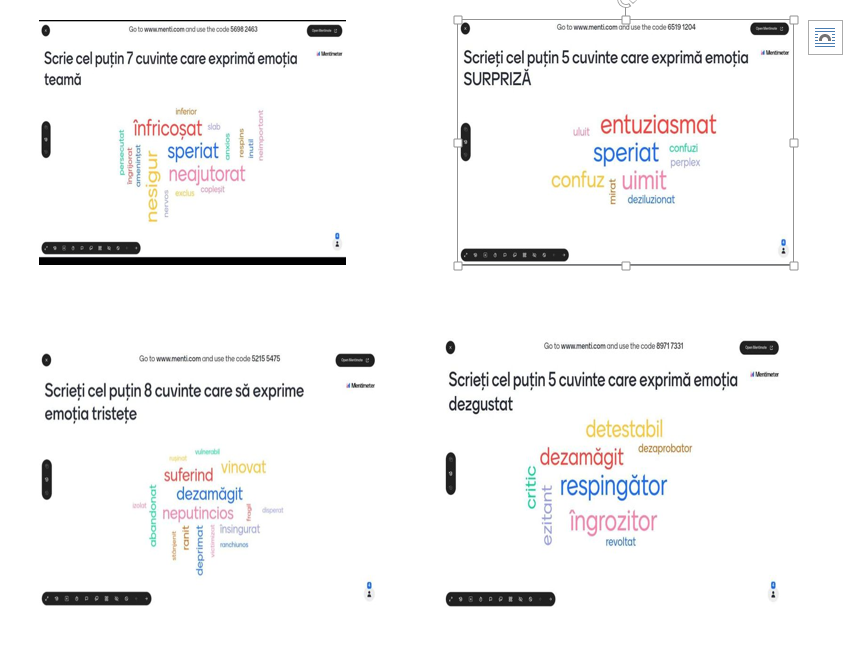
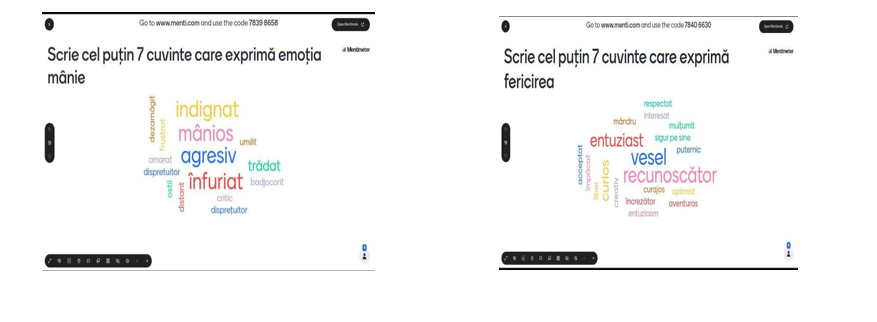
TEAMWORK * Students will work in groups to create works about emotions (words that express an emotion - "Word cloud"). Thus: GROUP 1: happiness GROUP 2: surprise GROUP 3: sadness GROUP 4: disgusted GROUP 5: angry GROUP 6: fear 6.7 Evaluation: Each student will paste in the table of emotions the sticker with the emoticon corresponding to his state during the activity. The teacher makes general assessments regarding the students' involvement in the activity. |

* Emotions "have colors..."
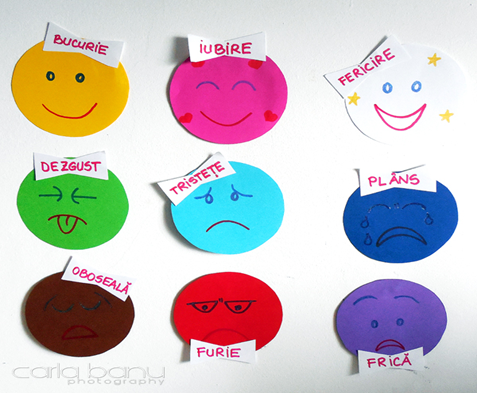
- students will name the appropriate color for each emotion according to what they feel.
6.6. Sharing and Mirroring
TEAMWORK
* Students will work in groups to create works about emotions (words that express an emotion - "Word cloud"). Thus:
GROUP 1: happiness
GROUP 2: surprise
GROUP 3: sadness
GROUP 4: disgusted
GROUP 5: angry
GROUP 6: fear
6.7 Evaluation:
Each student will paste in the table of emotions the sticker with the emoticon corresponding to his state during the activity.
The teacher makes general assessments regarding the students' involvement in the activity.WORKSHEET
EXERCISE 1
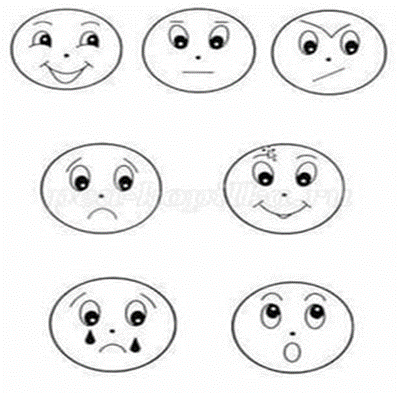
- Colour the figure that expresses anger.



EXERCISE 2
- MATCH THE PICTURES TO THE CORRESPONDING EMOTION.
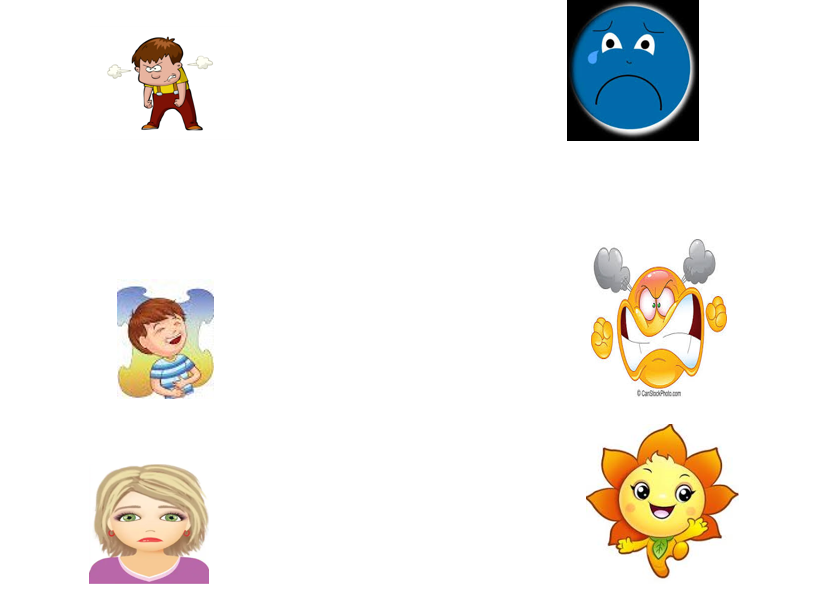
EXERCISE 3
- DRAW THE FIGURE BELOW (NOSE, EYES, MOUTH, EYEBROWS) SO THAT IT EXPRESSES AN EMOTION.
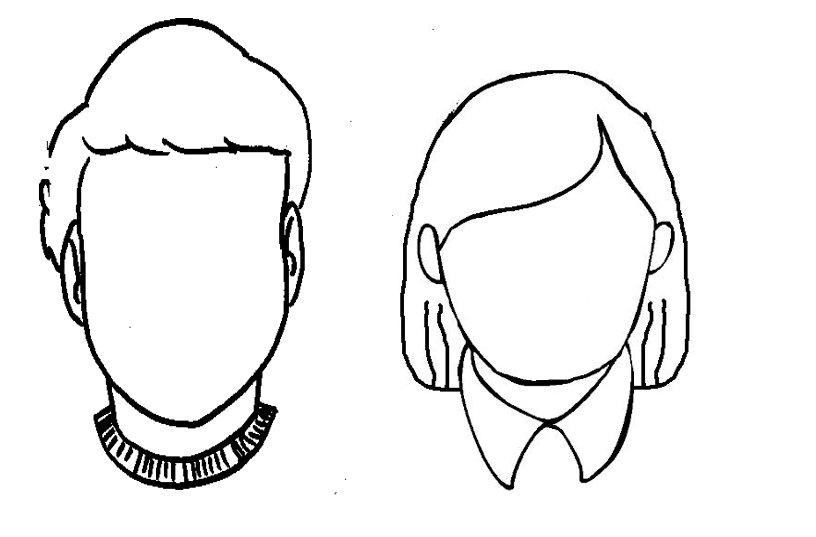
TEAMWORK:
WRITE IN MENTI: www.menti.com
- Write at least 7 words that express the idea of FEAR
https://www.menti.com/aljqmg8xmdwc
- Write at least 5 words that express the idea of SURPRISE
https://www.menti.com/almh49g2s7ck
- Write at least 8 words that express the idea of SADNESS
https://www.menti.com/aleq59d5wtwo- Write at least 5 words that express the idea of DISGUST
https://www.menti.com/algw8qcjqgwr
- Write at least 7 words that express the idea of ANGER
https://www.menti.com/aldn97a29xb6
- Write at least 7 words that express the idea of HAPINESS
https://www.menti.com/al74e2butwfh