Lesson Plan 3: Confidence and lack of self-confidence

LESSON PLAN 3
Lesson Plan 3: Confidence and lack of self-confidence
Subject: Social Studies
Grade: 3rd grade
Duration: 2 hours
Lesson drafted by teacher: Loredana – Doinița Chiscoci
1. Target Outcomes:
The development of students' self-confidence in order to be aware of its role in the learning activity and in any other activity
Cognitive Process Outcomes:
Identifying some defining moral traits of a person
The outcomes of the center discipline:
Obj 1- to make value judgments based on the motivational video;
Obj 2 - to identify the right words/expressions to students` heart content with self-confidence;
Obj 3 - to be aware of what some personal qualities are and at what moments they used them;
Obj 4 - to reflect on the messages conveyed by the films in relation to the child's attributes with self-confidence and overcoming a failure;
Obj 5 - to establish the specific traits for each of the two categories of children: self-confident/non-self-confident;
Obj 6 – speak about failure in a way that would not upset/help in the future.
1.2. Social Product Outcomes:
Exploring existing relationships among the people within the group
• Working in a team
The students will complete the Venn diagram (handout) with the two instances:
- Self-confident child;
- Child without self-confidence.
The different attributes of the two children will be visualized on the computer, the children just have to choose and write on the cards. They will establish common characteristics in pairs.
It will also be done on the computer to check the solutions for the different properties.
https://learningapps.org/watch?v=pxidu5mcj20
• Communicating
Students will watch the film: https://learningapps.org/watch?v=p2ae68ofc20 and they will discover what the main character needed to succeed.
Questions and Answers session:
How would you have felt if you were instead of the little boy?
What do the little boy's gestures show?
What did the boy need to climb the ladder?
How does the child turn out?
What did the father and grandfather try to do?
How did the child place his cap? What does this
gesture demonstrate?
How will the boy proceed in the face of the new
challenge, will he choose his father's version, his grandfather's or his own?
What helped the boy in finding the solution?
What attitude do the father and grandfather have towards the boy?
What lesson do we learn from the film?
• Being able to share problem and solution-oriented ideas
Reflection:
Does believing in ourselves mean we will always succeed?
How does self-confidence help us in times of failure?
• Fulfilling their duties and responsibilities
Students solve work assignments, both individually and in groups
• Being able to defend their ideas
Students support their ideas with concrete arguments
• Presenting the product effectively: The Reflection Journal
• Understanding the importance of cooperation and collaboration
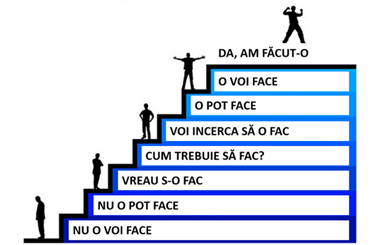
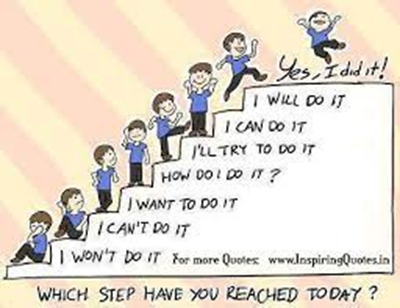
The teacher will give each group a sheet with situations they can find themselves in when they have to do something new. Students will be asked to reflect on the point they would like to reach.
2. Materials Used: video projector, calculator, online teaching applications, motivational video films, worksheets, flipchart sheet, flipchart
3. Resources:
http://clubami.alinablagoi.ro/cum-imbunatatim-stima-de-sine-a-copiluluiadolescentului
4. Learning Methods and Techniques: debate, heuristic conversation, exercise, gamification, Venn diagram
Problem Based Learning Method: solving an open-ended problem
Argumentation Based Learning Method: debate, argumentation, explanation
Project Based Learning Method: Investigative Journalist project
Techniques; Brainstorming, collaborative work: Venn diagram
5. Groups Considered to be Formed During the Activity:
The class will be divided into 5 groups/pairs of 5 students each.
6. Implementation Phase
The game "I felt..." for which we only need half a colored sheet and writing instruments (one or more, colored).
Worksheets with unfinished sentences:
I felt brave as a lion (not the one in the book...) when... .
I felt as smart as a dolphin when… .
I felt strong as a bear when… .
I felt playful like a cat when… .
I felt friendly as a dog when… .
6.1. Preparation Phase
The groups, the leader and the reporter have been established.
6.2. Presenting the problem situation to the student
The assigned student presents his Investigative Journal, in the second class.
6.3. Obtaining Information (Leading Questions)
I suggest the game "My trick", through which the students will do an exercise to look acceptably at a failure. They will listen to Adi (up to 1:47), after which they will choose an unpleasant moment in their life that they will present in an acceptable way, as it emerged from the material ("It's true that I had problems when …, but I know that it is in my power to get better results if…”) Students will write on a post-it each and whoever wants to will read. The teacher will start the list by presenting his or her own trick.
https://www.youtube.com/watch?v=KgsKtjS27lQ
6.4. Idea Development and Identifying Needs for the Problem
I will play the last part of Adi's message to the children and suggest that they make another material.
6.5. Product Development: The Investigative Journal
Identifying Possible Solutions: What can you do to boost your self-esteem?
Choosing the Best Solution: The best idea emerges.
Making the Prototype: Self-esteem takes shape, regardless of pleasant or less pleasant situations, "growing" through experiences, feelings, personal anguish.
6.6. Sharing and Mirroring: Some students "mirrored" themselves in situations and group discussions.
6.7. Evaluation